






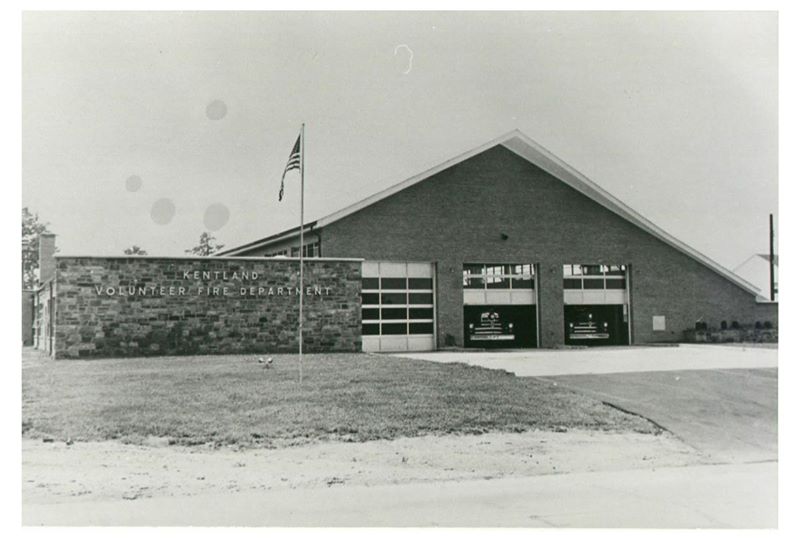
The Kentland Volunteer Fire Department (KVFD) was founded on February 3, 1951 when it was decided that there was not adequate fire protection for this, at the time, rural area minutes from Washington DC. Ten neighbors; Harold Anderson, Bob Baeschlin, Hugh McNeely, William Pearce, Walter Shea, Maurice Sullivan, John Wilding, Charles Weaver, Desmond Wonch and Steve Yuhacz of the newly constructed Kentland Community met at the home of Bob and Elaine Baeschlin. At this special meeting around the Baeschlin’s kitchen table The Kentland Volunteer Fire Department was born. The group appointed Bob to be the first President, John Wilding to be our Chief and Steve Yuhacz Treasurer. The KVFD was now on its way to becoming one of the best fire departments in the world.
By collecting donations in the area through newspaper ads and a second mortgage Steve Yuhacz’s home the Department purchased its first pumper from Riverdale Heights Co. 13. A 1931 Ford/Buffalo Type 50-B open cab 500 Gallon Per Minute (GPM) pumper with 200 Gallon Water Tank (GWT) that came fully equipped and ready for operation; it was the core of the new department and pride of the neighborhood. The engine originally belonged to Riverdale Company 7 who, to not pay a $100.00 shipping fee, stole it from a flatbed railcar. Riverdale eventually sold to it to Riverdale Heights in 1947. Riverdale Heights then loaned it to Chillum Engine Company 44 until Kentland purchased it in early 1951 and put it in service as Engine 1. The engine was kept in Bob’s driveway at 7135 East Inwood Street, where people would call to report a fire. Bob would crank up the siren to tell all the volunteers in the community there was a run. Ever since then, the KVFD has followed the simple value of “Always do whatever is necessary to get a fire truck, with firemen ready to do a job, to the fire.”
Kentland, through the years, has not, by any means gone without setbacks. The department, averaging only 50 calls a year from the beginning responded to primarily brush fires, one of which the pride of the young department, (the original 1931 pumper), flipped over on Columbia Park Road, after only 5 months of operation with Kentland. Walter Shea became the first Kentland Fireman to be injured in the line of duty. Miraculously, he was not hurt seriously and nor has anyone else in the history of Kentland; however Engine 1 was a total loss.
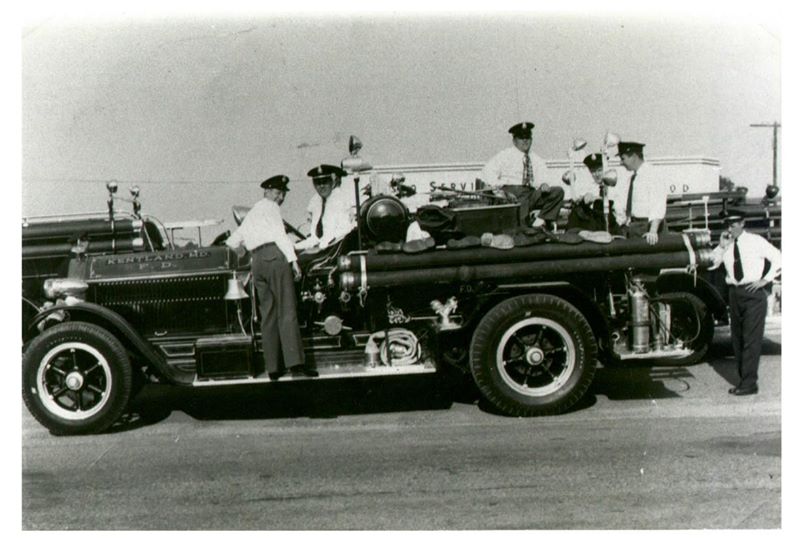
Not giving up, the department reacted in a way that established a standard for the following generations. They rose what little money they could and for $100.00 bought a 1928 American LaFrance Metropolitan #2505 and assigned it Engine 2. The 1000 GPM/ 100 GWT pumper came from the city of Hyattsville, who had originally paid $13,000 and nicknamed it the “Red Devil”. The pumper featured a right-hand, chain power drive; something like what you would see on a bicycle today. Hyattsville won many awards with the Red Devil; her 1000 GPM rating was far superior to anything in the region at the time. That summer we put a charter together and became a Corporation on July 11, 1951 as “The Kentland Volunteer Fire Department of Kentland, Maryland”.
In 1952, The Department put a fund drive together, to build a garage at the Baeschlin residence for the “Red Devil”. The West Brothers Brick Company was impressed with the determination and ambition of the membership and donated land at 2626 76th Avenue, now the Mount Zion Church at 2626 Kent Village Drive, for the KVFD to build itself a much needed station house. The department did not have any kind of budget or account at the time so it relied on donations and newspaper collections.
The Men of Kentland built the new station block by block with technical support from the West Brothers. The station featured 2 bays just long enough for a card table and a fire truck in one bay and a watch office and fire truck in the other. At this time the department consisted of about 25 members, most members of the Kentland Men’s Club had joined and brought with them the tradition that new members were placed on 90 day probation. During their “probie” time new members were not allowed to participate in card games in the rear of the apparatus bays or drink on the property. Rummy was the game of choice for the men.
With the Pumper and building this new corporation met the requirements of the Prince Georges County Fireman’s Association so we submitted an application along with the $5.00 Membership Fee. In PG County, each new fire department gets the proceeding number from the last established department and Kentland was in line for 32. Bob fought for the # 33 for the department and it was taken in front of the PGCVFA council. 33 was the number of Bob’s favorite football player Sammy Baugh who played for the Washington Redskins, the team coincidently now playing in Landover, down the street from today’s firehouse. The number 33 was awarded to Kentland as long as we waited to join the Association until after the next organization. Not long after with help from Kentland members and $5.00 for their fee, Allentown Road Volunteer Fire Department submitted paperwork. In 1953 Kentland 33, Allentown Road 32 and Chillum-Adelphi 34 all joined the Association which represented 33 Engine Companies, 8 Truck Companies and 4 Rescue Squads answering 2,572 fire calls countywide. With membership to the Association Kentland was connected to the Fire Control Board in Hyattsville.
After using up all of the funds building the new firehouse and buying the American LaFrance, some of the firemen of 33 put their houses up as collateral for a loan from Citizens Bank in the amount of $24,000 to finance the purchase of a new fire engine in 1954. Our first Seagrave #N-3455 was a 750 GPM pump with a 300 GWT and Canopy Cab that was painted red and put in service as Engine 331 in early 1954. The pumper featured a split hose bed walkway and top mounted booster reel.
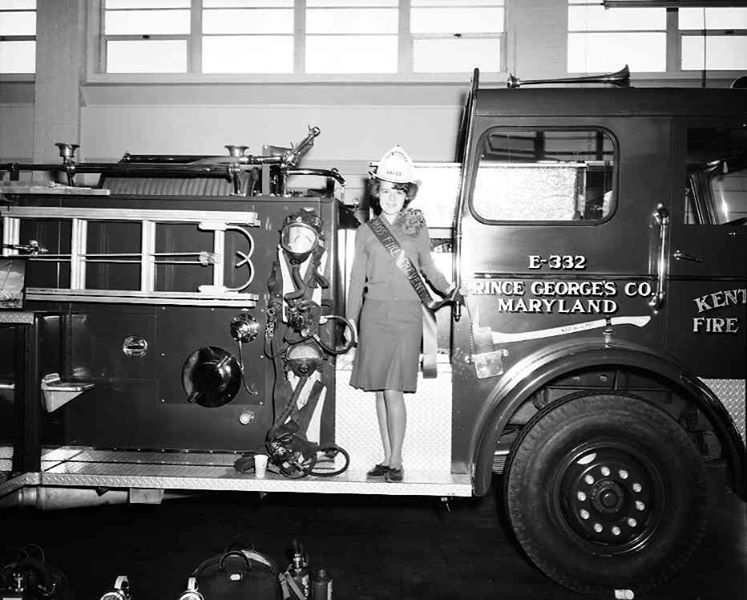
Just two years later in 1955 we purchased another Seagrave #H-8150 for Engine 332 almost identical to the ’54. The only difference was the nose of the new piece was chrome and there was a wagon pipe at the rear of the hose bed. This new pumper cost $36,000, much of which was raised through the new Ad-Valorem Fire Tax that was enacted in early 1953. The taxes collected in our district paid for $25,000 of the new pumper. Though the Ad-Valorem tax allotment was well spent, it was not sufficient to maintain the operations of the growing Kentland Volunteer Fire Department. The Major fund raising activity during this time was the annual carnival. Begun in 1952 and continued each summer until 1958, the carnivals were a source of fun, friendship and funds.
The spirit of service spread and by 1958 the Kentland Volunteer Fire Department had over forty members. By now the existing quarters had been outgrown. A building committee, chaired by Graham Lewis drew plans for a new building on Landover Road at 77th Avenue (later Prince Georges Avenue and now Firehouse Road). With a loan of $90,000 secured by the Ad-valorem tax, the new building was under construction, again under the guidance of the West Brothers and using their donated brick, members built by hand their new firehouse. The Dedication of the firehouse took place on April 26, 1959.
Also the same year we purchased another new engine for $50,000 for Engine 333, this time a white paint scheme was used, our first four engines (1928,1931,1954,1955) and our next four engines (1963,1963,1969,1969) were all painted red with gold lettering. It is still unknown why we painted this engine white. The truck was slow and had engine problems which gave it the nickname “White Elephant” The Deluxe Model 531-B, Anniversary Edition Seagrave #L-4000 had a 251 Horsepower gasoline V-12 motor, 750 GPM/ pump and 300 GWT with a 3 man Canopy Cab.
Now with three relatively new fire engines (1954,’55,’59) and a new firehouse, the young company had reached big time in fire department circles. This was capped when in 1959 Kentland hosted the Prince George’s County Fireman’s Association Convention and got to show off the new firehouse and equipment. To top it all off, one of Kentland’s own, Graham Lewis was elected to President of the Association.
The 1960’s brought many new challenges to the young but strong department responding as far away as Hughesville for tobacco barn fires. Kentland firemen were kept busy in the 60’s battling a rash of apartment fires. Developers were constructing “garden style” apartment buildings all over the area because of a need for low-income housing. This new style of building forced fire companies to develop new tactics to combat quick burning buildings. By the end of the garden apartment boom over 1,200 buildings were constructed in Kentland’s first due.
In 1961 a red Buick ambulance was purchased and allowed for an even greater service to the growing community. The ambulance would run out of the rear of the addition as Ambulance 339. Later that year the department also went onto establish a new communications system. They purchased their first two-way radios to communicate in-route to and operate on a fire. The Kentland Firehouse also installed a direct line connected to the South and North side PG County Dispatch Centers in Capitol Heights and Hyattsville. Now, instead of getting calls via “party line” telephone, Kentland was part of the first direct line communications dispatch jurisdiction in the country, also first two way mobile and handheld radios.
Kentland Volunteers were first on scene of the 1963 train wreck that occurred in the wee hours of the morning just off Route 50 where the White Elephant supplied the fire ground for 3 days straight, being refueled on scene. Also in 1963, Kentland purchased two more all red cab-over Seagraves #N-9425 and #N-9426 as Engine 332 and 331 for $65,000 each. The new pumpers featured 750 GPM and 300 GWT on the new KB style cab; in 1969 they would get an 8 inch mid body white stripe. Four men drove to Wisconsin to retrieve the new pumpers in March of 1963, while at Seagrave they talked about a ladder truck and were shown drawings of a new kind of platform truck. A second white Cadillac as Ambulance 338 was acquired fully equipped for $25,000. The White Elephant and the 1954 Seagrave were sold to Accokeek to make room for the new 1963’s. The 1954 was reassigned as Engine 333 and ran until 1967 when the department sold it to Union Carbide for $7,000.
Seagrave #N-9425 was reassigned as Engine 461 in 1969 and painted white with an orange mid-body stripe in 1977 then reassigned Engine 462 in 1978. As part of a deal for a stake body utility pickup truck, Both 1963 Seagrave pumpers were sold to PG County in 1980. In 1983 PG County put red scotchlite over the orange stripe and Reassigned the pumper as Reserve Engine 8 until it was removed from service in 1988. The twin Seagrave #N-9426 was reassigned as Engine 332 in 1972 and got the same white paint job with orange stripe in 1977. When the county purchased this pumper there was a shortage of ladder trucks. The county shop removed the pump, tank and rear compartments, installed forward facing jump seats and married the tractor with the trailer of old truck 22 which was a 1949 American LaFrance 100’ Tiller. This Hybrid of mix of Seagrave/ALF was named Reserve Truck 7 and ran faithfully in the county until 1990.
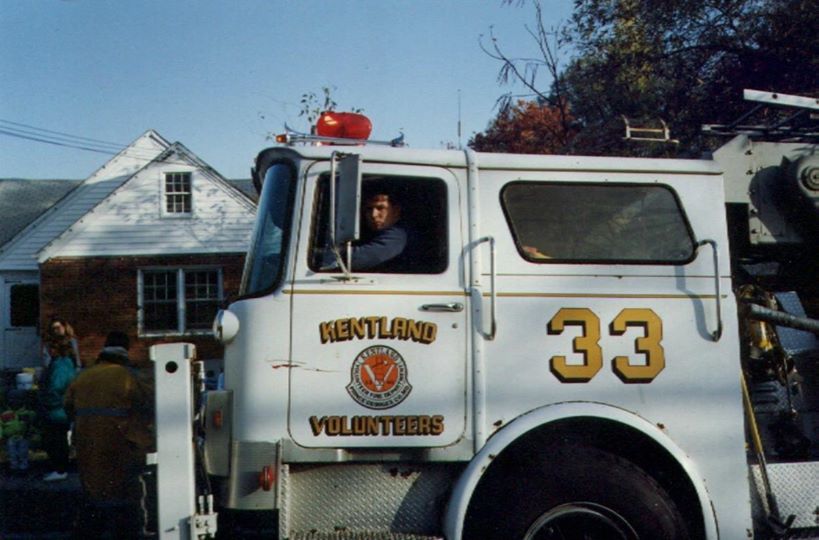
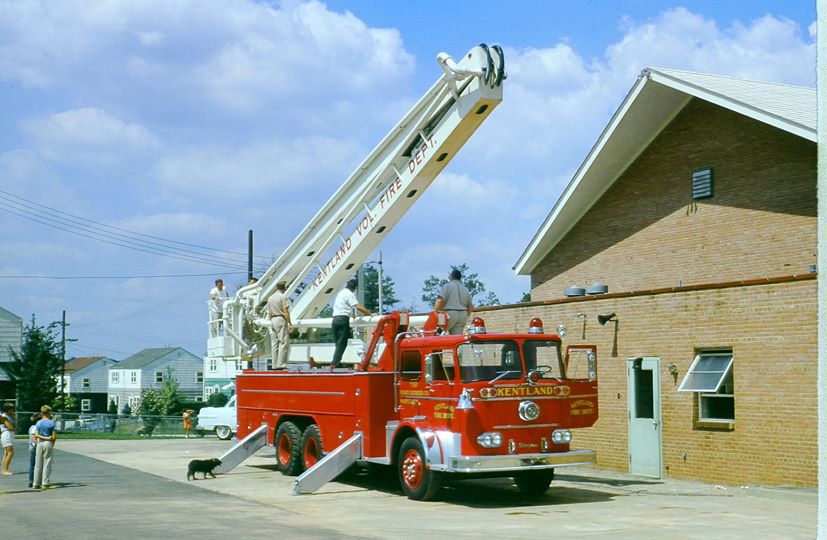
Just meeting the basic needs of the area was not enough for this new department that had come so far in just over 10 years. Kentland bought the first Seagrave KR Eagle Snorkel and took delivery early 1964 placing the truck in service on February 15. Truck 33 was painted all red with yellow lettering to match Engine 331 and 332. The Young Spring and Wire Company of Sandusky Ohio built the three piece steel boom with an aluminum platform for Seagrave. A four inch waterway carried water to the platform which had a 700 pound tip rating. The truck took three minutes to raise and rotate 360 degrees. As an innovative, experimental piece of apparatus the snorkel was not foolproof. At forty feet long it was eight feet shorter than any other 90 foot platform at the time, but was hard to maneuver in traffic with a top-heavy boom weighing 11,000 lbs. Only three were ever made, and Kentland was the only volunteer department to purchase one. The unique capability of the boom was realized by CBS when they leased it to film the Inaugural Parade in 1964. The snorkel added a new dimension of firefighting capabilities in the county being special called on almost all multiple alarm building fires. There was a section of rope kept in the platform because towards the end of its time at Kentland it would malfunction in the air and firemen would have to climb down.
During October of 1970 the jacks failed and the truck rolled on its side and was sent back to Seagrave. The boom was X-rayed for cracks and the jacks replaced. Upon completion of the work the truck returned to 33 with new boom lettering and an eight inch white stripe down the side with white lettering. The rims were replaced with new aluminum instead of painted red. After 10 years of service the already worn out truck had seen hundreds of fires and was plagued by hydraulic problems. In 1973 we sold Truck 33 to the Bath Fire Department in New York for $35,000. Today it still operates in upstate NY as a tree trimming truck with new hydraulic components.
On Thursday, May 2, 1963 Kentland Volunteer Fireman and PG County Policeman Alfred Steinat, badge #31, was shot and killed while making a traffic stop. Unbeknownst to Officer Steinat, the suspect had just left a service shop without paying for a repair bill. As Officer Steinat spoke with the suspect in the front seat of the car he was shot in the chest by the suspect, who was armed with a .45 caliber handgun. Despite being mortally wounded, Officer Steinat pursued the suspect a short distance and returned fire. He collapsed as he attempted to get back into his patrol car. The suspect later committed suicide. Officer Steinat was only 26 and had served with the County Police for 1 year. He was survived by his wife and four children. Al held an officers rank at Kentland in 1959 during the station dedication but was not present for the firehouse photo in 1955 leading us to believe he joined in 1956 or 1957.
During the Vietnam War twelve Kentland Firemen were sent overseas to fight. George Dove, a Kentland Contract man, was the first to go being drafted in 1966. That Christmas the membership took up a collection and sent him gifts, cigarettes, lighters, magazines and toothpaste. This started a tradition every year. During the November meetings monies were raised to support our troops. Once again however a Kentland Fireman was killed in the line of duty. Frederick William Murphy, known to his friends and brothers at the firehouse as Freddy, was born at PG on June 17, 1950 and grew up in Brentwood, MD. On his 16th birthday he joined the Tuxedo-Cheverly Volunteer Fire Department # 22. During this time he attended Northwestern High School and graduated with the class of 1968, also during that year Freddy joined Kentland after his 18th birthday. He was only a member for a short time before going thru boot camp and getting shipped overseas as a Staff Sergeant with the 101st Airborne Division “Screaming Eagles” . Freddy began his tour in country on March 17 1971 and was killed in action fifteen days after his 21st birthday on July 2 1971 in Thau Thien, South Vietnam. His name is etched in “The Wall” on Panel 03W-Line 97.
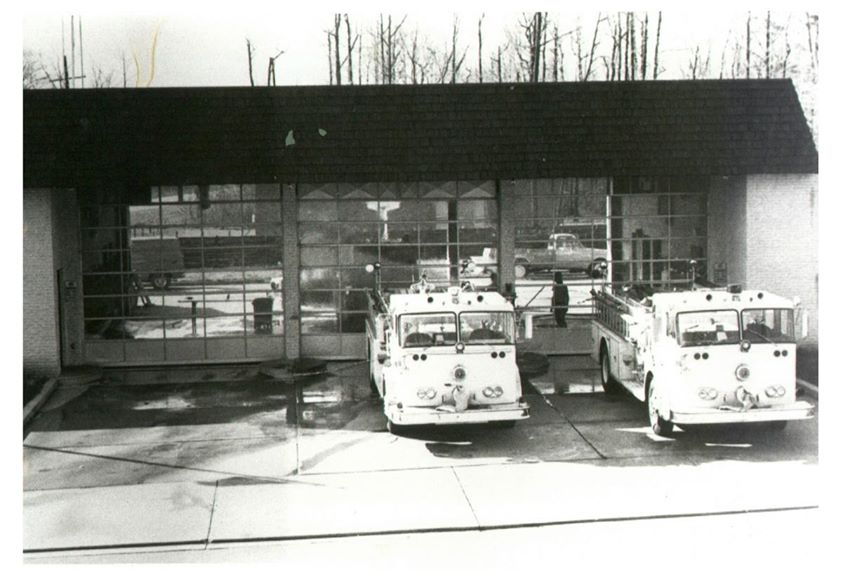
The vast expanse of development had now reached into what is known today as Kettering, The North Hampton Housing Project had just built thousands of townhomes and single family houses in the area and offered us a $10,000 loan to build a new firehouse, terms of the loan stated if we provided fire protection for 10 years the loan would be paid. The leadership of Kentland saw this and wanted to keep up with the advancement so in 1965 we bought 6 acres of land from the Bowie family on Landover Road for $125,000 and plans were drawn up for a new 3 bay firehouse. The plans were approved in august of 1968, groundbreaking on the property started that same month and by September of 1969 the firehouse had been completed by Greenhorne & O’Mara Architects for $80,000. Greenhorne & O’Mara also added a store room (Section 8 bunkroom) to the Prince Georges Avenue side of Engine House 33 in 1966 for $53,560.
With the plans for 46 being draw up in 1967 Kentland looked for further expansion. We bought land at Lottsford and Enterprise road for a third station from the Cobb Family for very little money; The Cobb Family had lived in Kent Forest during the 1950’s and was good friends of the department. Greenhorne & O’Mara again drew plans for us as we started to get building permits for the property; however the piece of land was not zoned for a firehouse. The leadership of Kentland met with the Maryland National Capital Parks and Planning department many times but could not come to a resolution, therefore dreams of a third station were never realized and the land remained undeveloped till it’s sale to the Kent District Rescue Squad. The rescue squad also failed to convince MNCPP to give building permits and the property was sold.
The November 1965 monthly meeting served as election night and as with all election nights in the 1960’s and 1970’s any member running for office had to pitch in $5.00 along with $250.00 from the company for dinner before the meeting. Also during the November meeting the membership voted to hire firemen to man the firehouse during the daytime hours. There was a lack of available members able to respond due to the fact that most worked regular jobs during the week. Some worked as Electricians, Bricklayers for West Brothers, Oil delivery men, Ironworkers and Carpenters but most members were PG Policemen or DC Firemen.
On January 1, 1966 Hans Johnson and Jim McCormick were the first Contract Paid Men to staff the firehouse; they were paid about $2,200 a year, in contrast the price of a pack of cigarettes in the company machine was .35 cents. Along with paid men during the day the membership moved to have Live-In volunteers take up residence in the firehouse on March 8, 1966. Four men were allowed to live at the firehouse as long as they furnished their own footlocker and kept the basement men’s game room clean. The Contract Men worked very well for Kentland and a great relationship formed, however other stations had problems. Each fire company had its own rules, salary, working hours and working conditions. Just 3 months after our Contract Paid Men started working for Kentland they were absorbed into the County Government Merit System as county employees.
During the Riots in April of 1968 Kentland was the base of operations for the County Fire Department. 21 PG county departments sent over 200 men into the district to help combat over 1,400 fires. Most Kentland men, if not at work in DC, stayed back to man the task forces ready for spillover rioting. The county police lined up along Eastern and Southern Avenues with shotguns to deter Rioters from crossing into PG County, and it worked. Weeks after the riots Kentland men were sent to Odenton in Anne Arundel County to help battle a 4 alarm brush fire indicating the diversity of responsibility. Also this year the department ordered 20 silver painted leather helmets to match the aluminum helmets they were replacing.
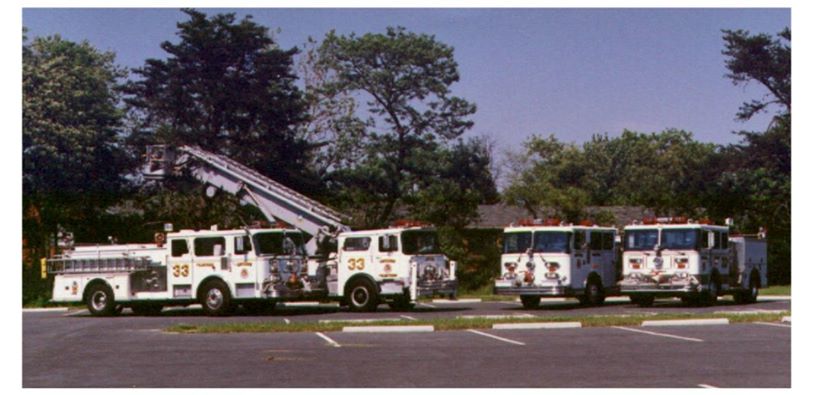
Kentland took delivery of two red 1969 cab-over Seagraves #R-4541 and #R-4542 as Engines 462 and 332 respectively on January 13, 1970. The Engines had 1000 GPM Waterous pumps with 500 GWT. As we opened our second firehouse at 235 Thaxton Parkway (Now 10400 Campus Way South) in April of 1970, each station was given a 1969 wagon to run frontline and a 1963 pumper for reserve. The new firehouse was welcomed by students, homeowners and businessmen alike in the new Kettering Community where Engine Company 46 ran about 200 runs its initial year.
Seagrave #R-4541 was repainted white with the orange stripe in 1978 to match the rest of the fleet. Then it was taken to Yankee Coach in Palmer, Mass to have a Spartan Monarch CFC 2000 aluminum two door cab and new body compartments for $29,216. This pumper was given to the Waterville, Pennsylvania Fire Company in 1995 for $1. The other 1969 Seagrave #R-4542 was reassigned as Engine 331 in 1972, got the white paint with orange stripe in 1977 and then reassigned as Engine 461 in 1978 before being sold to the Bendersville Community Fire Company of Pennsylvania in 1983. Bendersville ran the pumper as Engine 7-1 until 1999. Kentland reacquired this piece in 2003 when current Chief Tony Kelleher bought the pumper back from another private owner for $4,500. Today it is housed at firehouse 33 in its original red with white stripe coloring lettered as Engine 331.
Prior to 1971 the Department operated autonomously in cooperation with neighboring volunteer fire companies. Then The County adopted a home rule charter form of government which created a county fire department, headed by a Fire Chief, to coordinate the volunteer companies and growing career force. Funding prior to the change in government came in from donations and other monies rose by the individual companies (through bingos, dances etc.) and from the Ad-Valorem fire tax which was repealed in the new charter.
The most difficult problem the department was encountering at this point was not the increased populations nor was it the new firehouse. It was the change in membership due to age as well as volunteers leaving the area. Another aspect facing the evolving department was the change in the County’s fire service system. Unwelcomed by most, the county government started taking over control of most of the funding and increasingly over components of the firefighting operations. Many believed that the change in membership and the change in the system would lead to the elimination of most volunteer fire departments, Kentland included. Kentland seemed particularly vulnerable because the community had changed so much; the aging of the department had deprived it of expertise and experience; and Kentland’s history of an independent spirit seemed most threatened by the new county bureaucracy and the loss of funding control.
Those who predicted Kentland’s demise did not understand what the founders had done. They had passed on to a new generation the belief that The Kentland Volunteer Fire Department was something special and that its unique greatness would continue to prevail no matter what the surrounding circumstances. The new generation of members, many sons of the original firefighters or friends who had virtually grown up in the department toughed out a few years without money placing emphasis on firefighting performance. Kentland 33 was now running well over 1,000 Engine Company runs and no company in The County of Prince George ran more working fires. The respect that had once been earned in part by physical things like new stations and who had the shiniest new fire truck was now earned by uncommon, hard working, fire ground action.
The ambulance service was incorporated as the Kent District Rescue Squad in 1968. At the time the ambulances were responding out of the rear of section 8. With incorporation the ambulances were sold for $7,000 to the Rescue Squad and moved to different quarters in the 7800 block of Barlowe Road. The Rescue Squad was supposed to run independent of the fire department but due to lack of money management the Rescue Squad was disbanded and the ambulances moved service to firehouse 46.
As the 70’s moved into the 80’s the department began to venture back into success financially. Bob Baeschlin returned as President to lead the way with new fund raising ideas. In 1975 Kentland purchased a Dodge Power Wagon Custom 300/Pierce 250 GPM pump and 260 GWT to become a brush fire unit running out of Firehouse 46. Upon delivery department leaders realized the new unit’s potential and it was assigned as Mini-Pumper 33. This gave the department the ability of sending only two firefighters on minor runs, while still maintaining at least one crew to staff the engine in case of a fire dispatched simultaneously with or after the first run. The members also used the Mini as an attack pumper for some of the longer hose lays in our Garden Apartment Complexes. The Engine would connect to a hydrant and the Mini would lay 3’’ supply through the courtyard from the Engine to the front of the building, sometimes a 600’ lay. The Crew from the Engine rode the backstep of the Mini and pulled a line once in front of the building. The practice was stopped in the early 1980’s and we began driving the Engines into the courtyards and used 650’ lines as well.
The winter of 1978 brought on more than just a blizzard. As the snow fell several hundred people converged on the Dodge Park Shopping Center across the street from the firehouse and began looting stores. Kentland’s bravest responded swiftly and covered the entrances to the stores with water allowing the Prince George’s County Police Dept. to respond to the scene. Once again KVFD was recognized for its diverse service to the community. During the Blizzard which dropped over 2 feet of snow the United Farmers of America were protesting and marching on Washington. Thankfully they brought their tractors with them and Kentland took advantage of the situation. The members hired two farmers during the 3 day storm, Tractor 331 and Tractor 332 plowed on over 150 runs.
In 1980, the department again purchased two new twin Seagrave 1250 GPM and 500 GWT pumpers #K-73956 as Engine 331 and #K-73957 as Engine 332. The pumpers were painted white with a thin yellow line above the door emblem and yellow lettering with black shadow. This 1250/500 configuration would become the standard size for all Kentland pumpers. The new pumpers came equipped with three boxes for hose built into the front bumper. The middle box obviously for the front suction and the two side boxes were for a new idea, the “Kentland Bumper Line”, thought of by Life Member C.L. Farmer. The 1954, 55, 59 and twin 1963 pumpers had all attack and supply lines coming off the rear. The twin 1969’s had two “Mattytdale” cross-lays of 100′ and 200′ with supply lines off the rear. The 1980’s featured 100′ of 1 1/2” hose in the driver’s side box and 150′ in the officer’s side. The Kentland Bumper Line, like the 1250/500 setup, would become a staple on Kentland pumpers still to this day. Unlike other places who use front bumper line for auto or trash fires, Kentland uses the line for our first due House Fires. Around the turn of the century Engine Captain Rych Pullen standardized both lines off the front to 150′.
The Seagrave #K-73956 was reassigned Engine 333 in 1982 and 461 in 1983. In 1990 it was rebuilt by Fire Apparatus Unlimited with a Duplex D-350 cab and new high side body compartments and ran as Engine 461 until being removed from the fleet in 1994. The other 1980 #K-73957 ran as Engine 332 until it was rebuilt by Fire Apparatus Unlimited in 1990 with a Spartan Monarch four door cab and new body compartments for $84,900. When the pumper returned it was assigned Engine 462 from 1991 until 1994 when it was reassigned to firehouse 33 as Engine 333. When the Rescue Engine arrived in 2000 this pumper was again reassigned as Engine 334 until 2004 when it was sold to Bakersfield Fire District in West Virginia with the 1989 Mini Pumper.
Happy with the way our 1980 Seagraves were holding up to the wear and tear beating an Urban Engine Company takes, the department decided again to buy a Seagrave #M-79215 in 1982 as Engine 331. The new pumper was the first engine in Maryland to be equipped with a 4 door cab. Also it came standard with the “Kentland Bumper Lines” and a 1250/500 pump/tank setup. This pumper was nicknamed “The Harley” because of its loud exhaust, it was rehabbed by Fire Apparatus Unlimited in 1990 replacing the seats, front bumper, rear step and pump panel cover for $38,400. This pumper was reassigned as Engine 462 in 1994 and remained at 46 until it was sold to a broker in Alabama, who then sold it to the Mathias-Baker Fire & Rescue Co. #4 of West Virginia in 2000. During this time Firehouse 33 on Landover Road was running over 2,500 calls per year and Firehouse 46 in Largo, with intensive development in its first due area was up to over 1,000 incidents for the year between the engine and the ambulance.
Still unsatisfied with its capabilities and service to this increasingly urban neighborhood, the firefighters noted that ladder truck companies did not adequately service Kentland and Firehouse 33 was an ideal location to have one. However, some of the department’s leadership was skeptical and saw all of the dangers involved thinking the volunteers would burn out from too many calls. The majority of members disagreed though. On May 1, 1987 members traveled to New York City and at auction for $35,000 the department bought a used 1978 Mack CF Aerialscope 75’ Tower Ladder #CF611FAP-1912W. The truck had been assigned to FDNY Tower 17 in the South Bronx. In a scene reminiscent of the founding forefathers the Volunteers rehabbed the truck in the apparatus bay at Firehouse 33. All work from rebuilding the cab to painting the rig was done by the members and on January 1, 1988 “Truck 33” was officially in service and in its first year did 1,142 runs.
For $191,356 in 1989 we purchased our Eleventh consecutive pumper from Seagrave for Engine 332, a JB-40DH cab #X-79964. This new pumper has an 8V92 motor and is so fast the members nicknamed it “THE JET” also equipped with the standard 1250/500 pump and tank and Kentland Front Bumper Lines. THE JET was rebuilt and painted by M&M in 1994 and came back to us with the current paint scheme we use today, the white pumper with 1 inch black top, 4 inches orange middle and 1 inch bottom black scotchlite make up the mid-body stripe around the pumper. Also black 33 with orange outline and reverse shadow was affixed to the rear doors. Also in 1989 we replaced the 1975 Dodge Mini Pumper with a Ford F-450 4×4/ Marion #39495, 250 GPM / 250 GWT for only $58,450.
In the 80’s Kentland transformed its Bingo Nights into Casino Nights offering Vegas Style betting games, this was a huge source of revenue for the department. In 1994 we sent Truck 33 and THE JET to be rehabbed, bought 2 Pierce Pumpers and 2 Ford Explorers, replaced the two trailers that were temporary living quarters and the temporary metal structure that housed Engine 333 and the Mini pumper on the east side of the firehouse with a brick and block building. The eastside addition was a welcome relief to the live-in firemen with 13 individual 10’x12’ rooms replacing the open barracks style bunkroom of the double wide.
For $432,110 we purchased two Pierce Arrow pumpers #E-8808-1 and 2 for Engine 331 “Doin The Deed” and Engine 461 in 1994. In total Engine 331 ran approximately 84,000 responses and nearly 1,680 working fires in its 14 years of service. Unfortunately the engines didn’t stand up to the wear and tear beating an urban fire engine takes and were taken out of service in 2008. Engine 331 was sold to the Big Island Virginia Fire Department for $30,000 in 2008 where it runs as Engine 2 “STILL Doin The Deed” and Engine 461 was sold to Perez, Argentina for 25,000 where it runs as Engine 46. The 1989 Seagrave Engine 332 “THE JET” moved up to run as the frontline wagon until the 2008 Seagrave was put in Service.
Truck 33 was sent to the Stevenson plant of Richmond, which was home to Baker Engineering’s Aerialscope factory. There the boom was removed and taken apart, once apart the workers realized there was cracks in the boom that were improperly welded in the 1987 rehab and decided to replace the 3 fly sections. The old main boom, bucket, superstructure, hydraulic jacks and the new fly sections were built onto a new FWD (Seagrave) chassis with a 1994 FWD JG-00DH four door cab #74221. All this work was done in the last 5 months of 1994 for $427,000. In 2002 the tower was damaged in an accident and was sent to Interstate Mack to get a new FWD four door cab, right side bodywork and a new platform #F-2243. The tower was affectionately known to the men of Company 33 as “Sally” and served faithfully until August 2010. Kentland was awarded a $650,000 grant for a new tower and Sally was sold for $140,000 to the East Quoge Fire Department on Long Island. The EQFD painted her “Boars Head Colors” black over red with gold leaf lettering and she now responds as Tower 7-6-11. Above the windshield on the “brow” the EQFD wrote “SALLY” as a testament to her old name.
On Friday May 26, 1995 at 3:00 P.M. the county fire chief Roberts contacted Kentland Fire Chief Bryan Teague and advised him that the career personnel would not be in on Monday for Memorial day, or any other day that week and that they were being pulled out of firehouse 33 to better staff surrounding fire stations. Teague protested the decision thinking his guys would wear out, and so did the rest of the county, but they pulled together in true Kentland fashion and have had at least 4 dedicated Volunteer Firemen staffing Firehouse 33 every single day since.
When the county took over control of the monies collected by taxes for fire suppression in the early 1970’s they also took on the responsibility of maintaining all the Volunteer firehouses in the county due to the fact they controlled our only source of income. The county put together Station Management funds for which departments could use to purchase necessary equipment and Capital improvement projects for additions and renovations could be purchased. With the county knowing we had large sums of money from casino nights, we unwillingly replaced the roof over the main apparatus bay for $130,000 in 1995. The county inspected our rafters and found them in deteriorating condition so the roof was condemned and torn down by the county. The apparatus bay remained without a roof for 3 months until the county pressured Kentland into footing the bill to replace it, saying they would start a capitol improvement project that usually takes 5 years to grow interest on. 5 years passed and we still didn’t get any money, the county stated that capital improvement monies couldn’t be spent for work previously done and they couldn’t fix what previous administration messed up.
Under the vision of then Chief Rick Riley Kentland set out once again to further its service to the community by purchasing a 2000 Pierce Dash #11257 for $360,000. With hydraulic tools on loan from Wheaton Rescue Squad and others borrowed from FDNY Rescue 2 the new unit was put in service as Engine 333. Originally the members were skeptical of riding the new unit, the engine guys thought it was too big to run as an efficient Kentland Engine Company, the tower guys, while interested in the new extrication capabilities, didn’t want to ride on anything with hose. A core group of Rescue minded individuals constantly drilled with the new equipment cutting up multiple cars outback firehouse 33 and on the streets. The county wouldn’t let Kentland run 333 as a Rescue Squad; they tried pressuring us into putting an ambulance in service first. The membership decided to run 333 on all vehicle incidents in the first due, many times extricating victims before the Rescue Squad on the assignment arrived prompting the motto “GO HOME, WE GOT IT”.
Whenever there was a Kentland Chief Officer at 33 or 46 Engine 333 was special called to all accidents in 46’s area. Chief 37 and 18 also special called the unit at times when several Rescue Squads were out of service in the county; both Chiefs were told afterwards they couldn’t special Engine 333 because it was not a recognized Squad. For 3 days in 2004 Engine 333 acted Squad 14 after their unit was involved in an accident. And during a fill in at company 27 Engine 333 acted as Squad 27 for the night, both times causing confusion and was very controversial.
During the events on September 11th, after word of the horrible incident at the Pentagon our department placed 4 Engine Companies and 1 Tower Company in service within 1 hour. Engine 332 was transferred to the District of Columbia Fire Department Firehouse #26. Engine 332 eventually responded from DC to the Pentagon to assist with operations. Tower 33 was special called to the Pentagon at 9 PM to assist with operations and Kentland still had three crews to provide coverage to the citizens of P.G. County. Tower 33 was placed in service at 7 AM the next day.
In the 2002 Firehouse Magazine Annual Run Survey Kentland Engine Company 33 placed 3rd with just over 6,200 runs. Of the 3,844 Engine Companies surveyed nationwide in 2003, Kentland stepped up to 2nd place with 6,325 runs out. This statistic represents the ongoing dedication, pride, and heart that the members of the Kentland Volunteer Fire Department put forth.
Just before midnight on July 2, 2003 the Box was sounded for 6100 Block of Westchester Park Drive. Berwyn Heights Truck 14 arrived with fire from the 4th floor of an 18-story Hi-Rise. As the incident progressed, multiple civilians and firefighters became trapped on or above the fire floor. Truck 33 was called on the 3rd alarm, as they approached the scene Division Chief 5 (Fusco Co.14) requested Truck 33 to pass all the Second Alarm units and its crew report directly to him on side 1. The RIT team brought out the firefighters as Truck 33’s crew entered the fire building where they searched the upper floors for trapped occupants. Truck 33’s exterior team positioned on side 1 to removed 3 people from the fourth floor, one man was lying on his balcony with fire venting above him. The driver of Truck 33 used the ladder to crash through the balcony railing and rescues the man who would have jumped but couldn’t get above the railing due to extreme heat. The truck then repositioned on Side 3 and removed 8 more occupants from the floor above the fire.
Around the turn of the century plans were drawn up for a new fire station in South Laurel, to better provide Engine services to the City. At that time Company 10 was the lone engine on the northern end of the county as station 49 only provided rescue services. The County Fire department, in a move to save money and not staff or build another firehouse, tried to put a county owned engine in service at 49, the leaders of Laurel Rescue didn’t want a county owned engine running out of their station so decided to spec out a rescue engine.
An apparatus committee came to Kentland, looked at and test drove 333, and then bought a 2003 Pierce almost identical to 333. The county made a deal that if we taught 49 a pumps class at MFRI for two weekends we could get in on their 90 day Rescue Engine pilot program. Engine 333 was finally recognized as a fully fledged Rescue Squad on April 22, 2004. This hybrid unit that had been in service for almost three years was reassigned as Rescue Engine 33 and would be dispatched to assignments as a Rescue Squad or an Engine Company depending on need. Also in 2004 we replaced the 1989 Miniature Pumper with a brand new Ford F-450/ Knapheide/ Delmarva #08500 featuring a Slagle’s 200 GPM / 206 GWT pump/tank combination skid unit for the combined price of $65,000.
2005 started with a bang, shots rang out and Kentland recorded the first homicide of ’05 right across the street from the firehouse on Dodge Park Road, just 45 minutes after midnight. As the hot summer of 2005 heated up so did the violence, Company 33 was going to nightly shootings and got double doses on the weekends. That year was the worst on record since the drug wars of the 70’s and 80’s. 173 Homicides were accounted for in PG County, compared with 148 in 2004 and 134 in 2006. On one such incident, the assailants fired their shots while riding by on bicycles, presumably due to gas prices in the Metro-DC area reaching $4 per gallon. A bloody gang war played out on the streets of Kentland every night claiming the lives of 19 people in our 3.9 square mile first due. In contrast our sister firehouse 46 (outside the beltway) recorded only 2 homicides in their 10 square mile first due.
As summer came to a close on September 27, it was been noticed that our apparatus bay air conditioning unit has stopped working. A routine call was made to the County Operations Center, who in return quickly sent out an HVAC repair technician. During his investigation into exactly why our (very large) A/C unit was not working a very interesting finding was made. The repair man was sad to report that someone had scaled the rear of the station house and the motor for the unit was stolen. When asked what the “Street Value” was for an old A/C motor these days, the technician said (as he shook his head) “not too sure”. Just another day in Kentland.
During the evening hours of Thursday July 7, 2005 the Rescue Engine responded to the Beltway for a crash and the crew of Engine 331, still in quarters, received an unexpected visitor. Due to storms in the area the bay doors of Station 33 were open, apparently providing an opportunity for a distraught gunman from the neighborhood to get out of the rain. The man walked into the firehouse and when approached by firemen, he became angry, started screaming that he had a gun, and then barricaded himself in the fire chief’s office. Communications was notified prompting PGPD to declare a “signal 13” (officer in trouble) in G-sector. No less than12 patrol cars promptly responded, eager to speak with the man. PGPD’s ERT team was alerted but before the SWAT team could arrive, the man was “persuaded” out of the office by patrol officers and taken into custody.
In 2008 Kentland turned back to the tried and true ways of Seagrave Apparatus Manufacturing when we bought the last fixed cab JB-40DH Commander II #78E79. The new Engine was named “Old School”, this was not only chosen because it is quite possibly the last fixed chassis ever made in the USA, but also due to the fact that this pumper is designed like most older pumpers were. For example it’s simple, easy to work off of, possesses features of Kentland VFD pumpers in the 1960’s and has hose and water to put out fires. This seems to be a thing of the past when speaking of modern fire apparatus. The pumper features include a 2006 60 series Detroit Diesel 515 horsepower motor, Hose loads: 2-Kentland Front bumper lines, a 250’ and 400’ 1-1/2’’ pre-connect, 800’ dead load of 2-1/2 inch line with 150 foot pre-connected bundle and a 200’ 1 inch “red line”, and most importantly NO CROSSLAYS. On Monday July 9 the new wagon was put in service, with Life Member and past Deputy Fire Chief Ed Smith riding the line on the wagon dedicated to him. The first call was a crash on the beltway followed by a 2nd Due Box Alarm where Ed got the first line in the door!
With a $650,000 AFG apparatus grant Kentland again turned to Seagrave for the 15th time to build a new Tower Ladder. In August 2010 the apparatus committee met with representatives of Seagrave and discussed the possibilities. Now 13 months later the tower has been delivered and striped with all tools mounted. PG County shops will soon inspect the Tower and approved it for firefighting duties.
Yes, Kentland has changed in many ways throughout the years. But through the hard times of over Sixty years, the special vision of service — ‘fiercely independent and innovative’ — set forth around the dinner table of one man’s home has remained the driving force of the Kentland Volunteer Fire Department.
Acknowledgments
This history was written with the help of Tom W. Shand of Emergency Vehicle Response. Tom spent many nights in the basement historical archives at Seagrave and many Saturdays at the PG County Historical Society looking though old Firemen’s Convention books.